


I don’t really like Christian music.
I used to be more okay with it; I worked as a full-time worship leader until a vocal cord injury put me in permanent retirement. But even then, perusing new releases to find a decent song to introduce to the community was more necessary evil than enjoyable pastime.
Since then, I’ve listened less and less to anything in the “Christian” genre.1 At first because it reminded me of my derailed career plans. But then I started contracting earworms every now and then when an old hymn or indie deep cut came on. And I realized I wasn’t just nursing a grudge on a failed life track: I just didn’t like most “Christian” music.
Which brushes up against a crucial feature of my personality: my absolute, thorough, obsessive adoration of music. Listening to it feels like how I imagine a phone feels charging. I gave up listening to podcasts and audiobooks and any unnecessary noise a few months back, but couldn’t stomach cutting out music. I rarely get any writing done unless there’s a song in the room. Yet, the music that punctures the soul is rarely what you’d lump in the “Christian” category; it’s almost always “secular.”2
By “secular,” I don’t literally mean secular. You wouldn’t hear them in church, but they still feel soaked in vague divine longing. The singer believes they’re crooning for some long-lost love or imagined muse, but from a theological standpoint, I can’t rationalize the passion as anything but a subtle crying out for transcendence—an implicit grasping at their deepest desire to know and be known by God.3 In other words, I don’t think art can escape God.
It’s why almost all music—secular or sacred or satanic—can’t help but have God as a character.4 He’s always in the room because He’s what’s breathing life to our creative capacity5—regardless of whether they’re singing about a knockoff version of His love mined from a romance or attempting to diametrically oppose His love by singing anti-God sentiments.
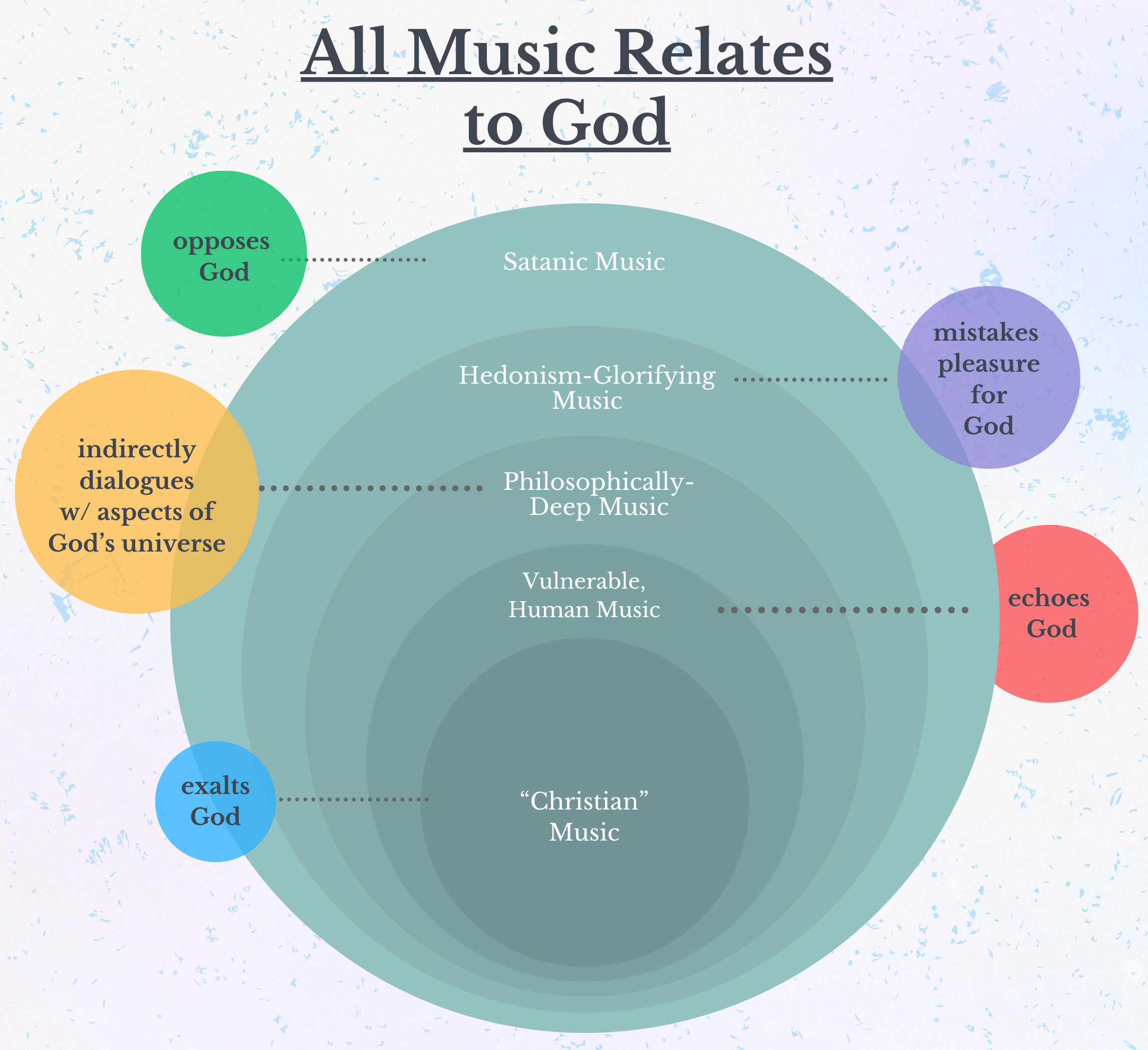
So although not all music glorifies God, all music can glorify God, because it all gravitates around Him in one way or another.
But at the same time, there’s some historical weight to elevating purely Christian music to a sacred pedestal. While “secular” music echoes God’s goodness, only “Christian” music exalts it.
So despite how much I might dislike Christian music, I don’t want to dislike it.
All that said, here’s my best attempt at a theology of music—highlighting the power of music while troubleshooting how to non-cynically appreciate even the most unappealing Christian music.
Let’s start with
What Hell Sounds Like.
In The Screwtape Letters, the chief demon tells his apprentice that there are only two sounds you’ll never hear in hell:
“music and silence.”6
Which feels surprising but accurate. Silence is one of the most peaceful things that can graze our ears, and music one of the most life-giving.
Music activates the same neural reward pathways as food, drugs, and sex.7 It lowers cortisol (the stress hormone) and heightens social-bonding systems.8 Music memory is retained even when other memory systems erode, making musical therapy incredibly beneficial for Alzheimer’s patients.9 It’s why I curate a new playlist 6-8 times a year: it gives me a soundtrack for mentally revisiting specific seasons of life.10
Out of every artistic medium, music gets the most embodied. Dancing with others increases the pain threshold and boosts solidarity with everyone around us.11 Some suggest that moving and singing in rhythm with others is the single most happiness-inducing activity we can do.12 Apparently, music gets so sonically embedded in us that it’s been found that chewing gum can get a song unstuck from your head—the new rhythm of chewing dislodges the last rhythm your body was holding on to.13
Something about the way God crafted our sense receptors to metabolize chords and notes incentivizes joyful transcendence.14 As such, all these melodic vibrations and frequencies are a reminder that He meticulously designed our universe with more goodness and beauty than He needed to. We’d technically be able to survive without music, but a life without it wouldn’t be life to the full.
Dietrich Bonhoeffer made a similar observation from prison.15 God wants to be our supreme love, of course; but He also wants to be enjoyed alongside His other “melodies.” His gifts don’t compete with our love for Him; they enhance it. Music is like a backboard for bouncing our love off of, engracing us to enjoy God more and more.
Thus: hell can’t have music.
Theology of Music
I admire most theologians that I’ve met. But very, very few of them share my love of music—let alone my love for obscure indie bops. Which is unfortunate, because music plays a crucial role in theology.
John Calvin even wrote that “among the other things which are appropriate for recreating people and giving them pleasure, music is either the first or one.”16
Similarly, Martin Luther said, “Next to the Word of God, music deserves the highest praise.”17
Music is this powerful because it’s almost like a secondary, passive proclamation of the superabundance of God’s created reality. It’s also why you can experience hints of the divine in music whether you’re a Christian or Non.
I know this from anecdotal experience. Back in high school, we were informed by our first period teachers one morning that a classmate died in a drunk driving accident the night before. Only 16, the younger brother of a close friend. The usually frustratingly noisy hallways were pin-drop silent. A few hours later, some students grabbed some instruments and sat in the center lobby, started playing instrumentals that slowly evolved into worship songs. They weren’t good singers, but it sounded ethereal and haunting. I wasn’t a Christian, but their words glued in my head (“Set a fire down in my soul, that I can’t contain, that I can’t control, I want more of you God”). I stopped and watched them for a second from the third-floor balcony. Couldn’t put words to the solace of it for years.
Music is like a therapist for our hurricanes of emotions—our doubt or grief or joy or longings. Which is because, as Jeremy Begbie notes, “Music is capable of connoting dimensions of God’s character or nature—specifically His ‘weight’ and ‘majesty’.”19
Or, as the Christian philosopher Peter Kreeft put it, “God is love, and music is the language of love; therefore, music is the language of God.”20
And as a gift wrapped with dimensions of God’s character and love, it’s capable of “appealing to the heart”—as if something about its frequencies and vibrations shiver past analytical exteriors, crawling into our inner hiding places.21
This is why even non-“Christian” songs that express doubt or incompleteness or faux contentment can resonate with Christians—and why non-Christians can resonate with “Christian” songs.
Echoing
The other day, my wife put on some music while she was getting ready. From two rooms away, I only heard the muffled melodies and basic song structure. Once we were in the car, I asked what worship songs she was playing. “That was Noah Kahan’s new album.”
I put the album on the aux. And as I relistened, I heard Kahan as folksy mirror to anthemic modern worship music. It’s some of the most longing-drenched, crying-out-for-something more, incomplete-but-don’t-want-to-be kind of music that we have nowadays. It’s squarely in the spiritual, not religious camp—but he’s grasping for something that’s sticky and meaningful and matters.
Despite declines in church attendance, people have been more willing than ever to attend another kind of worship event: the modern concert venue. And Kahan’s borderline mysterious resonance with Gen Y through A allows him to consistently sell out some of the largest venues on the planet.
Which is fascinating, because many of the words Kahan sings have little practical meaning for a large audience (i.e., “I broke a bone / that never healed in my hand”). It’s honest poetic randomness. The words are like scattered pieces to a puzzle that eventually points toward ultimate beatitude—he just doesn’t yet know how to put the pieces together. But the sincerity of his search for a solution resonates. As such, they’re almost like secular stand-ins for worship songs.
Except, they’re just that: stand-ins—penultimate placeholders; music isn’t the capital B “Beauty” (aka, the ultimate good, eternal bliss, beatitude) itself. It’s an echo of God’s goodness. And if we treat the echo as if it’s the Beauty, we wind up feasting on a plate full of “dumb idols.”22 He’s always the thing behind the art—not the art itself.
Kahan is a perfect case study of echo without exaltation. Even though we can find loads of beauty in non-worship music, I don’t want to just rest content in music that only echoes His goodness—I also want music that exalts His goodness.
Exalting
In 1934, a Michigan family was cleaning out the attic of the house they’d just bought. They found an old Bible from 1733, filled with a bunch of notes scrawled throughout the margins. After donating a couple hauls, the Bible was tossed aside, forgotten. But a couple years down the line, it was rediscovered and, through handwriting and ink analysis, it was found that the notes in the margin were from the hand of Johann Sebastian Bach.
And in one of those marginal notes next to 1 Chronicles 25—where Levite musicians are appointed by David to “prophesy with harps, with psalteries, and with cymbals”—Bach wrote:
“This chapter is the true foundation of all God-pleasing church music.”
Later, in 2 Chronicles 5:12–13, which describes the singers and trumpeters at the dedication of Solomon’s temple, he wrote:
“In devotional music, God is always present with His Grace.”23
Arguably the greatest classical musician in history, Bach dedicated every bit of his music to God. At the top of all his sheet music, he wrote “SDG”—Soli Deo Gloria or “glory to God alone.”
Most of his best work was purely instrumental, blending the notes and frequencies of creation together to hallow God’s name. Bach’s music imbibes a sense of elevation—of a jubilee without words.24 He’s the best illustration of music that exalts God that I can think of.
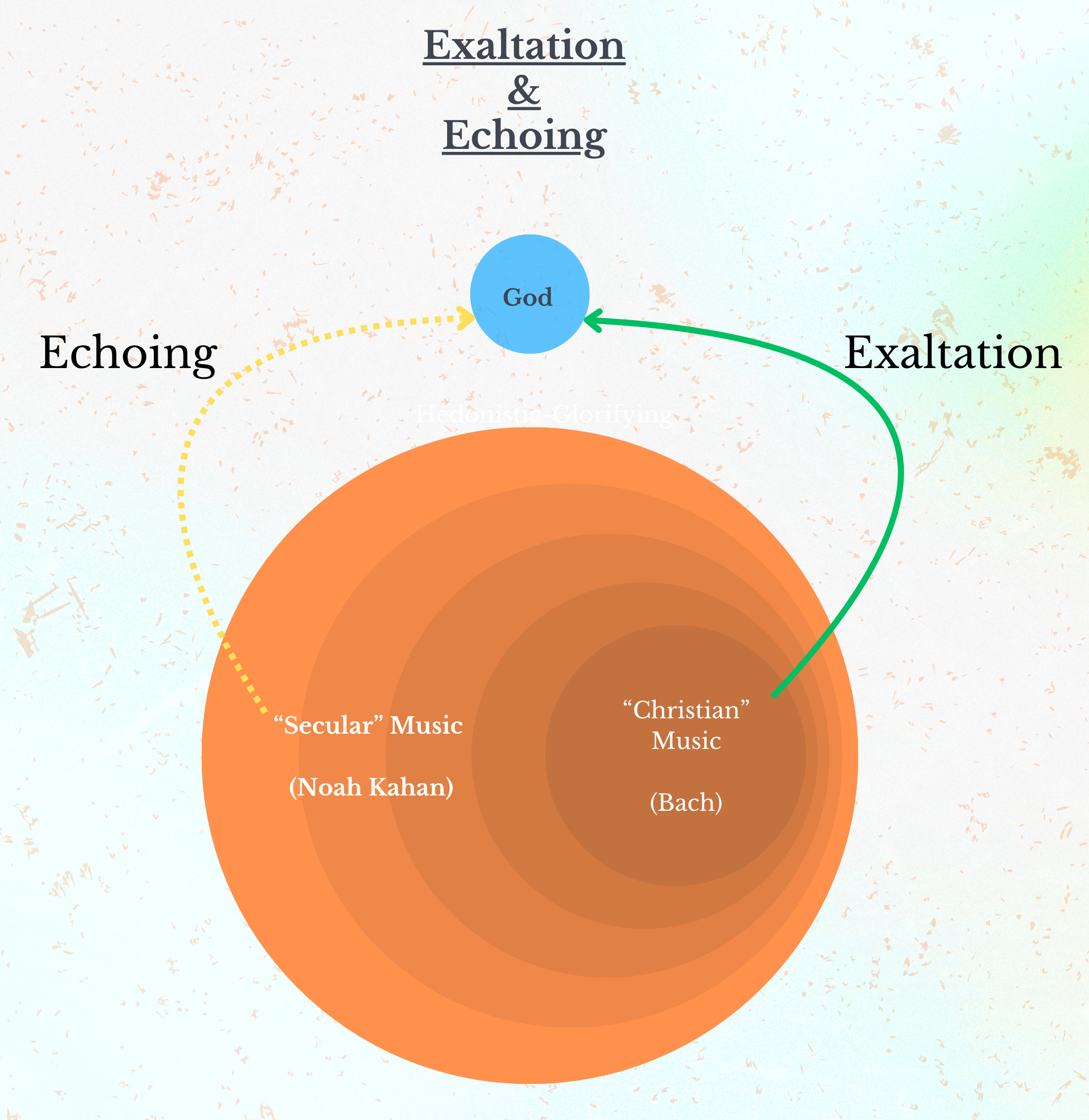
I said I don’t like Christian music at the beginning. But that’s not totally true, because I adore Bach. Playing his stuff feels like filling the room with Soli Deo Glori.
As such, not all Christian music is bad.
But there is, unfortunately, still plenty that’s bad.
So let’s end by hitting on
Exalting When You Feel Cynical
It’s become super popular to point out that “worship” isn’t just music. And that’s technically correct.25
In early church studies of what “worship” was, it was basically the whole of the church gathering.26 Attending someone’s home, receiving the eucharist, praying, giving money and time—all of it was worship, not just singing. In probably the foremost scholarship on “worship,” Andrew McGowan puts it flatly:
“Worship” is sometimes now a way of talking about music. This would have baffled Christians of the first centuries; music was often important for their communal gatherings, as were buildings or food, but music was neither the most central or distinctive aspect of their gatherings nor identified with “worship” as such, any more than other ritual activities were.
Again, he’s spot on. But the end of that last paragraph comes with an excellent one-liner toward any “worship isn’t singing” cynicism:
Yet sing they did.27
So while worship is more than music, it’s not not music. Despite all the faults and failures of modern worship music, we still have to fall back on:
Be filled with the Spirit, as you sing psalms and hymns and spiritual songs among yourselves, singing and making melody to the Lord in your hearts, giving thanks to God the Father at all times (Eph. 5:17b–20)
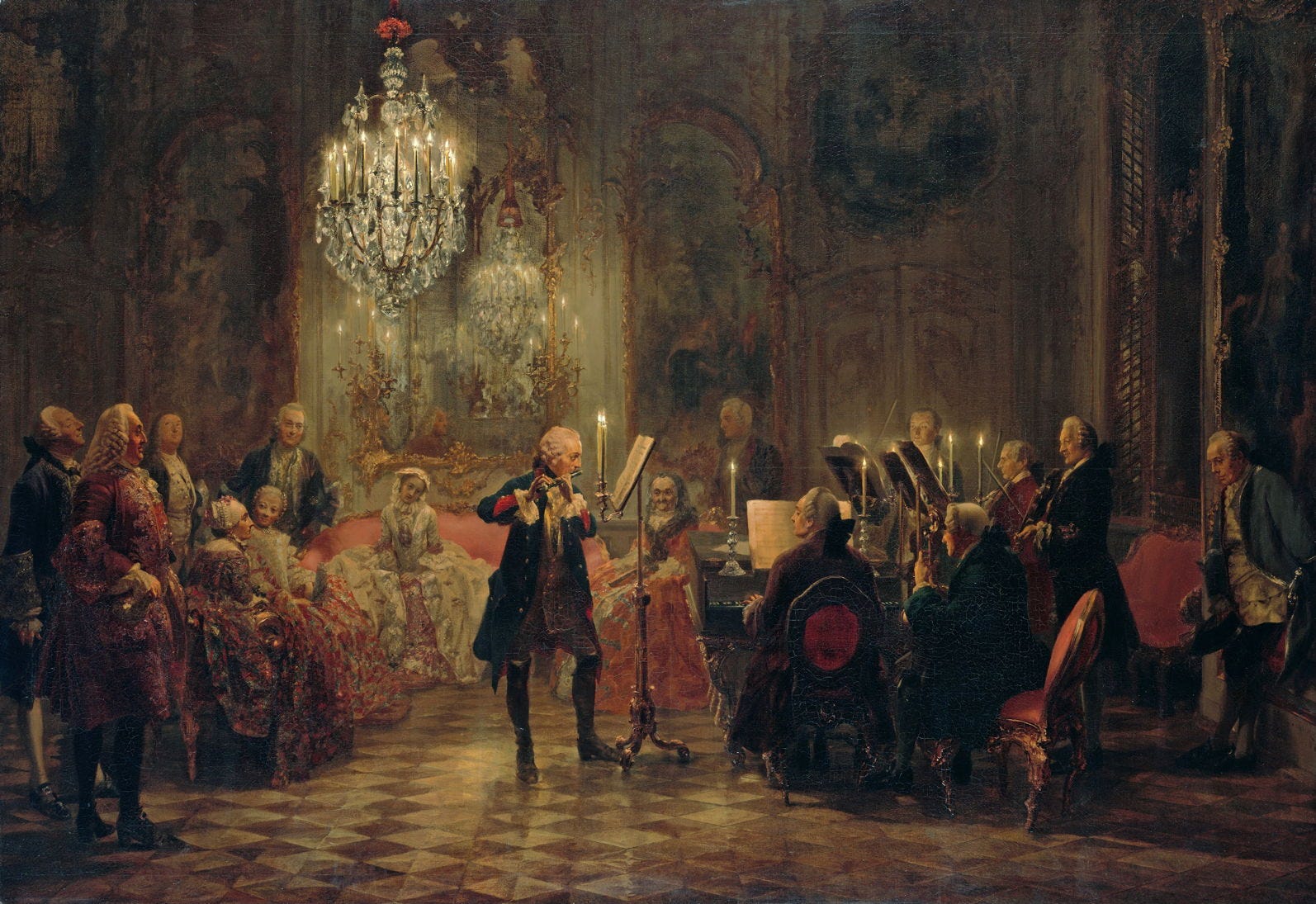
Maybe the best resource for getting over curmudgeonly worship singing is C.S. Lewis. Despite his love of music, he complained more about church music than any other writer I know of. He “naturally loathed nearly all hymns” and famously showed up to church late and left early just to skip the music.28
Yet Lewis landed at brushing past cosmetic issues with music and cultivating worship of the heart.29 Even if Lewis shuddered at the songs he heard on Sundays, he still aimed to uncynically worship in his heart, surrounded by imperfect community.
Whenever I’m feeling inclined toward cynicism, I remember how Lewis turned his distaste into a Judo-like spiritual discipline—flipping his annoyance into an invitation toward humility, love, and commonality:
I disliked very much their hymns, which I considered to be fifth-rate poems set to sixth-rate music.
But as I went on I saw the great merit of it.
I came up against different people of quite different outlooks and different education, and then gradually my conceit just began peeling off.
I realized that the hymns (which were just sixth-rate music) were, nevertheless, being sung with devotion and benefit by an old saint in elastic-side boots in the opposite pew, and then you realize that you aren’t fit to clean those boots. It gets you out of your solitary conceit.30
So yes, I don’t like most of what passes as worship music nowadays. But I don’t hate it, because it really does exalt God and generate positivity and joy and closeness to Jesus. If Paul could praise acapella in prison, we can stomach a plastic overproduced rendition of “Waymaker.” Appeasing my personal tastes isn’t the ekklesia’s highest priority.
Regardless of aesthetics and tackiness and taste, I want to worship and worship with others who are worshipping.
Also: My book’s available for pre-order!
I dislike using Christian as an adjective ever, but sometimes ya just gotta.
I similarly dislike the use of “secular” as a category that’s a fold of “Christian.” But as Saint Theophan the Recluse once said, “ya gotta do what ya gotta do, bromigo.”
Good examples of this kind of song are “Ocean Breathes Salty” by Modest Mouse, “Miracles,” “Afterlife,” or “Southern Sky” by Alex G, “Hammer” by Hana Vu, “The Cure” by Olivia Rodrigo, “Favourite” by Fontaines D.C., “Fool’s Gold” by Briston Maroney, “Triple Marathon” by Medium Build, “Motion Sickness” by Phoebe Bridgers, “Inner Monologue” by Jackie Hayes, “This Must Be My Exit,” by Oso Oso, “White Ferrari” by Frank Ocean, “ROS” by Mac Miller, “Sailor Song” by Gigi Perez,” and plenty others.
After talking with some of my metal head students, the subgenre of Black Metal is specifically designed for the worship of Satan. Which, although it obviously and intentionally opposes God, still treats God as a character within their musical creations. Even art that opposes Him can’t help but nod at Him, however subtly or antagonistically.
Theologically, this is because an essential function of the imago Dei is one’s creative will. According to Keas Keasler and Dallas Willard, “The imago Dei is structural in that it involves a human ability, but unlike other structural accounts, especially those of the early church and medieval scholastics, this ability is not rationality or moral consciousness but creative will…We are meant to exercise our “rule” only in union with God, as he acts with us. He intended to be our constant companion or co-worker in the creative enterprise of life on earth.” Dallas Willard, “Leadership as Love of God and Neighbor” (May 15, 2000), MP3, 20:15. Quoted in Keasler’s Kingdom Apprenticeship.
C.S. Lewis, The Screwtape Letters (New York: Harper, 2001), 119-120.
Interestingly, a landmark PET/fMRI study found that dopamine is released in the caudate nucleus in anticipation of a musical peak, and in the nucleus accumbens during the peak itself. Valorie N. Salimpoor, Mitchel Benovoy, Kevin Larcher, Alain Dagher, and Robert J. Zatorre, “Anatomically Distinct Dopamine Release During Anticipation and Experience of Peak Emotion to Music,” Nature Neuroscience 14 no. 2 (2011): 257–262.
Mona Lisa Chanda and Daniel J. Levitin, “The Neurochemistry of Music,” Trends in Cognitive Sciences 17 no. 4 (2013): 179–193.
Camilla N. Clark and Jason D. Warren, “Music, Memory and Mechanisms in Alzheimer’s Disease,” Brain 138 no. 8 (2015): 2122–2125.
2021’s post-4th-of-July playlist as I type this, bringing back loads of memories from the end of our first summer married.
Bronwyn Tarr, Jacques Launay, Emma Cohen, and Robin Dunbar, “Synchrony and Exertion During Dance Independently Raise Pain Threshold and Encourage Social Bonding,” Biology Letters 11 (2015); Barbara Ehrenreich, Dancing in the Streets: A History of Collective Joy (Holt, 2007).
Daniel Fujiwara, Laura Kudrna, and Paul Dolan, Quantifying and Valuing the Wellbeing Impacts of Culture and Sport. London: Department for Culture, Media and Sport, 2014. https://www.gov.uk/government/uploads/system/uploads/attachment_data/file/304899/Quantifying_and_valuing_the_wellbeing_impacts_of_sport_and_culture.pdf.
C. Philip Beaman, Kitty Powell, and Ellie Rapley, “Want to Block Earworms from Conscious Awareness? B(u)y Gum!” Quarterly Journal of Experimental Psychology 68 no. 6 (2015): 1049–1057.
Or: “Music has been given for our recreation and pleasure; to be more specific, for our ‘spiritual joy’—that we might rejoice and delight in God, which is our ‘true end.’” See Jeremy Begbie, Music, Modernity, and God, 16; See also John Calvin, ‘Foreword’, 95.
Dietrich Bonhoeffer, Letters and Papers from Prison, Dietrich Bonhoeffer Works, vol. 8, ed. John W. de Gruchy, trans. Isabel Best, et al. (Fortress Press, 2010), 393.
Calvin, ‘Foreword’, in Theological Treatises, 95.
Martin Luther, “Preface to Georg Rhau’s Symphoniae Iucundae,” in Luther’s Works, vol. 53, Liturgy and Hymns, ed. and trans. Ulrich S. Leupold (Fortress Press, 1965), 321–324 (at 323).
Peter J. Leithart, “The Theology of Music,” First Things, January 17, 2025, https://firstthings.com/the-theology-of-music/.
Jeremy Begbie, Music, Modernity, and God: Essays in Listening (Oxford: Oxford University Press, 2014), 15.
Peter Kreeft, Three Philosophies of Life: Ecclesiastes, Job, Song of Songs (San Francisco, CA: Ignatius Press, 1989), 102. You could theologically nitpick the life out of that statement, but it’s nice if you just leave it be. Similarly, Josef Pieper puts it like this, “Music, the fine arts, poetry—anything that festively raises up human existence and thereby constitutes its true riches—all derive their life from a hidden root, and this root is a contemplation which is turned toward God and the world so as to affirm them.” Josef Pieper, Only the Lover Sings (Ignatius Press, 1989), 11.
Begbie, Music, Modernity, and God, 16.
C.S. Lewis, The Weight of Glory (Harper, 2001), 21.
See Robin A. Leaver, J. S. Bach and Scripture: Glosses from the Calov Bible Commentary (Concordia Publishing House, 1985).
Wordless jubilation is a reference to Augustine’s idea: “We cannot say, and yet cannot be silent either…What are we to do, employing neither speech nor silence? We ought to rejoice! Jubilate! Shout out your heart’s delight in wordless jubilation!” Quoted in Pieper, Only the Lover Sings, 43-44.
For an interesting study of how worship came to be seen as only music, see Jonathan Ottaway, Adam Perez, and Lester Ruth, eds., How Worship Became Music: A Historical Sourcebook (Nashville: Abingdon Press, 2026)
See Alan Kreider’s “Worship” chapter in The Patient Ferment.
Andrew McGowan, Ancient Christian Worship (Grand Rapids, MI: Baker Academic, 2014), 112.
C. S. Lewis, “Letter to Mary Van Deusen, December 7, 1950,” in Collected Letters of C. S. Lewis, vol. 3, Narnia, Cambridge, and Joy, 1950–1963, ed. Walter Hooper (San Francisco: Harper, 2007).
For his most extensive thoughts, see C. S. Lewis, “On Church Music,” in Christian Reflections, ed. Walter Hooper (Grand Rapids, MI: Eerdmans, 1967).
C. S. Lewis, “Answers to Questions on Christianity,” in God in the Dock: Essays on Theology and Ethics, ed. Walter Hooper (Grand Rapids, MI: Eerdmans, 1970), 51–52.
The best “Christian” music is indie and not likely to ever sniff the radio or most worship services. I’m talking every genre or musical sonics and about all the those of life but from a Christian worldview. Artists like Andy Squyres, John Van Deusen, Gileah Taylor, Plead the Widows Cause, The Arcadian Wild, Leem of Earth, The Gray Havens, Jon Guerra, Diathke, Jess Ray, Taylor Leonhardt, Pomegranate, Gable Price & Friends, Skye Peterson, Indietribe, Chris Renzema, Sandra McCracken and on and on.
Thanks for the essay! Agreed, despite growing up drenched in classical hymns and singing the lead in “He’s Alive!” before thousands (we were the early version of Mega-church 😬), I’ve struggled for decades to adapt to contemporary Christian music.
Give me the masters, Beethoven, Bach Mozart, when I need some classics. Or Gas, Biosphere, Somers & Jónsi for an ethereal edge. Pat Metheny any day! And despite the “secular” connotations, I can’t but help worshipping. I take some of what is out “there” and re-create it. Give it words and meaning, or replace words in my liking (and hopefully His).
Listen to Beck’s “Ramona” and it seems impossible to me not to adjust the lyrics to “Jehovah, Oh, I’ve tried to be who you wanted…”
Several years ago I began “producing” a mental video of a young believer’s quest to live amongst the giants of this world, set to Samuel Barber’s “Overture to the School for Scandal.” I still replay it in my mind, each time I listen to the piece.
Yet, like Lewis I too have had to lower my self-illusions about “worship music” and shed the pride (even contempt) for melodies and (cringe) “words” to some of the contemporary music. Even then, I try to turn that time and attention to Him (while re-arranging words and tunes that are theologically questionable).
And yes, a look over to my wife belting out “Great Is the Lord!” is all it takes for the contempt to melt into a chorus of worship.