


Alarm screams, eyes crust open, and you’re faced with probably the most important decision of your day: give in to the path of least resistance, let the eyes crust closed, or get up and commune with the God of the universe.
Mornings set the tenor of our days.1 Waking up toward the difficult path makes for a tenor of alertness, intentionality, and vibrancy—while the easy path often slumps us into the opposite.
For all of life’s qualities we can’t control—the weather, graying hair, having to download a new app on your phone every single time anything new comes into your life ever—one choice that’s well within our control is our wake-up decisions. And one surefire way to make difficult choices less difficult is making a habit of choosing the difficult.
Yet, it’s common today to hear Christians criticize rituals or habits.2 Spiritual disciplines and rules of life get written off as Jesus-y Atomic Habits.
And so habit talk’s almost become taboo—as if following a rhythmic paradigm of spiritual practices is a pile of legalistic self-help heresy.3
Coincidentally, I’ve noticed that those who criticize spiritual habits also happen to passionately advocate church attendance, listening to sermons, and tithing.
You know, those things that you do once a week, every week, around the same time.
“Habit” is a crude, insufficient word, sure. But what’s a worship gathering? A Bible reading plan? The eucharist? They’re actions and sacraments attached to a specific rhythm because, at some level, we realize that their cadence enacts some effect (i.e., boosting intimacy with Jesus, shifting attention toward the Spirit’s work in us, increasing awareness of God’s will for our lives, etc.).4
And yes—spirituality isn’t just Atomic Habits with Jesus sprinkles. But coming into a deeper awareness of God’s grace should lead to a beautiful overhaul of every part of our lifestyle—habits very much included.
So even though habits aren’t everything—and they have nothing to do with our justification—an anti-habits mentality is a horrendous and unnecessary overreaction.
On top of that, I’d wager that the Christian misunderstanding about habits comes from this: self-help is all about habits for the sake of the self, while Christianity is all about habits for the sake of God and others.
To explain, let’s look at
How Faith Spread
How did Christianity actually spread?
It’s a question boatloads of scholars have wrestled through. And it makes sense why: the spread is kind of insane; in just a few centuries, Christianity went from a microscopic blip on the radar to becoming the Roman Empire’s central religion.5
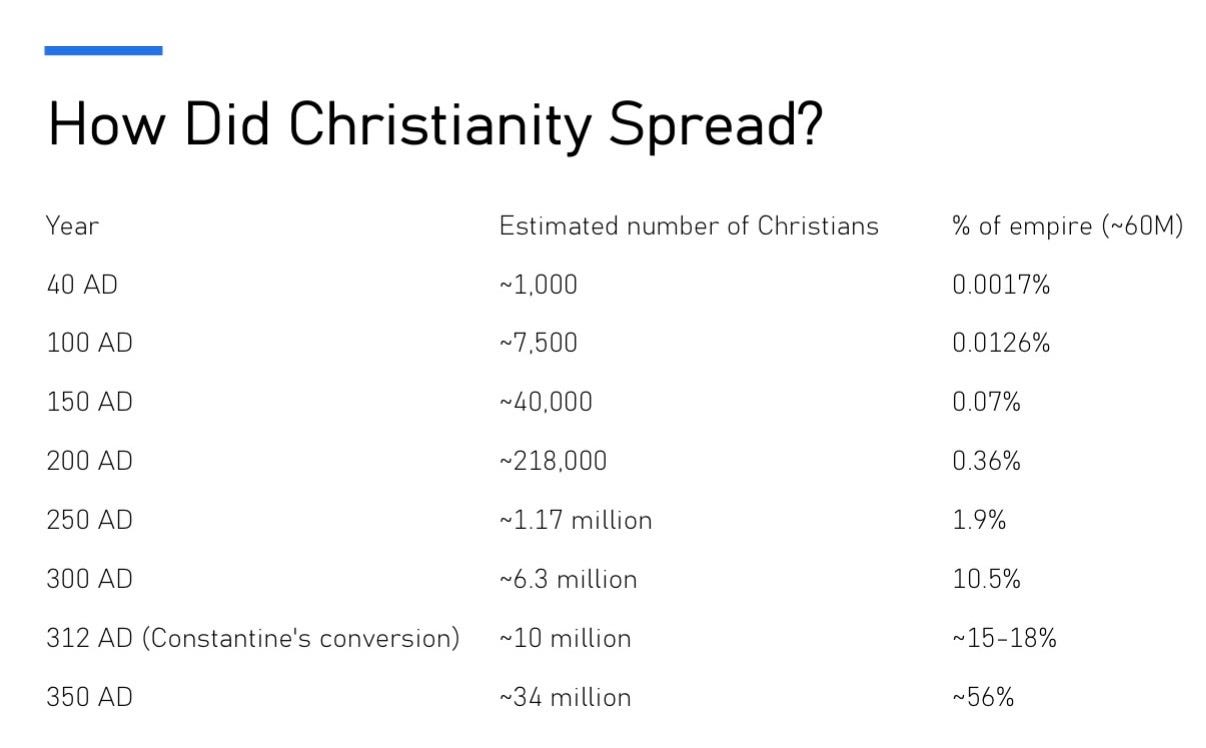
The popular narrative for the “how” is typically: Christianity spread because Christians were publicly martyred, which spread their faithfulness like a contagion to onlookers. Ya know: “The blood of the martyrs is the seed of the church” and all that.
That was undoubtedly part of it, but not the whole of it.
A century worth of scholars drafted out a couple top theories for how the faith spread:
Their supernatural gift to engage in debate across different religious and philosophical traditions.6
Their uncontainable passion that went head and shoulders above that of any other faith.
Their unique theory of the afterlife.
Their displays of spiritual gifts.
Their seemingly impeccable and subversive morality.
Impressive organizational skills.
Psychological force (via miracles and exorcisms).7
All of these factors are legit. But they miss out on two other crucial features:
patience and
habits.8
Patience in the sense of “long-suffering”—which is how one of the words for patience, makrothumia, literally translates. It has less to do with waiting than standing firm despite whatever complex situations life hits us with.9
Some early theologians even considered patience, along with love, the crown of the Christian virtues. In the time it took us to write a book on love, we’d already penned three on patience.10
This extra attention on patience is probably due to the way public evangelism plummeted after persecution upped around 68 AD. Some churches even started closing off their worship gatherings from outsiders.11 So patience became the practical response: because we couldn’t just run around screaming Jesus is Lord consequence-free, we took to patiently practicing Jesus’ way behind the scenes.
And what they were up to behind the scenes lands us at the second part of the equation: habits.12 Everything early Christians did was driven by an alternative set of habits that aggregated into a compelling, strange, and invertedly beautiful lifestyle.
They loved enemies, broke social and ethnic barriers, prayed in their rooms alone. Whereas their culture believed that the “gods cared nothing for the poor,”13 Christians treated the poor as if they were God Himself (Matt. 25:31-46).
If early Christians didn’t patiently imbibe alternative habits, there’s a good chance faith wouldn’t have spread the way it did. Jesus spells this out black and white in the Sermon on the Mount: “Let your light shine before others so that they may see your good works and give glory to your Father” (Matt. 5:16; cf. Phil. 1:27-30; Rom. 12:19-21). It’s why Paul’s excited to not only “share the Gospel” with the Thessalonians, “but also [their] own lives” (1 Thess. 2:8).
As church historian Alan Kreider writes,
It was not primarily what the Christians said that carried weight with outsiders; it was what they did and embodied that was both disconcerting and converting. It was their habits—their reflexes and ways of life that suggested that there was another way to perceive reality—that made the Christians interesting, challenging, and worth investigating.14
The early sources don’t indicate that Christians made more Christians just by winning arguments.15 That wasn’t their top tactic. Like Origen wrote: Christ “makes his defense in the lives of his genuine disciples, for their lives cry out the real facts!”16
Early Christians knew their stuff and wrote insanely intelligent philosophy, but they also knew that people needed more if they wanted to change their minds.
A lifestyle is always more convincing than an intellect.17
Our faith’s most compelling defense is a collective of hearts aflame for God.
As such, the best apologetic is you.
But How Do We Become an Apologetic When We’re Not Feeling It?
The other day I got a Hawaiian roll with a younger guy from church; he was rolling around in shame because he wasn’t spending much time in prayer or Scripture. “I’m worried I don’t love God. I heard someone say prayer should flow from our love for God. But I don’t feel like praying, so maybe I just don’t love God enough.”
This logic is sadly common. Basically: our actions should flow effortlessly from our state of mind and/or emotions.
It’s honestly one of the most crushing cultural beliefs: the idea that belief and feeling should lead to practice, and never the other way around.

But this logic is the ideal. And it’s rarely wise turn ideals into expectations.
Sure, spiritual practices should flow from a love of God. But the well of passion that bubbles over into action is often annoyingly dry. It’s rare to wake up so drenched in uncontainable love that we rush downstairs. Cherish it when it happens—but I personally can’t treat it as a prerequisite.
If I only took my wife on a date when I waited to feel an overflow of love and appreciation for her, we’d go on less dates. Not because she isn’t the loveliest of all created beings, but because life is hectic and busy and it’s easy to make excuses. If we don’t choose to intentionally resist that hectic busyness by carving out a specific time and space for practice, chances are, we’d practice dating less. There’s nothing inauthentic about building habits to sustain love; it’s just realistic.18
Same idea applies for most of Christian life. Like C.S. Lewis wrote,
“The rule for all of us is perfectly simple. Do not waste time bothering whether you ‘love’ your neighbour; act as if you did. As soon as we do this we find one of the great secrets. When you are behaving as if you loved someone, you will presently come to love him.”19
Similarly, from N.T. Wright:
“[I]f we wait to start practicing these behaviors until we ‘mean them’ from the bottom of our hearts, we will wait a long time and probably mess up a lot of lives, including our own, in the process.”20
We often become what we act out. Smokers have better success quitting when they spend a day cosplaying a lung cancer patient than when they’re just told “smoking is bad.”21 Similarly, in 2007 a group of researchers randomly assigned two groups to either practice prayer or attend lectures on the Gospels. After a month, the congregants who attended lectures felt no discernible difference in their spirituality, while the group who practiced it reported an increase—with some even claiming to have heard God’s voice for the first time.22
Point is: we can’t rely on “feeling it.”
Our beliefs don’t always lead to practice. Much of the time (most of the time, imo), practice is what leads to belief.
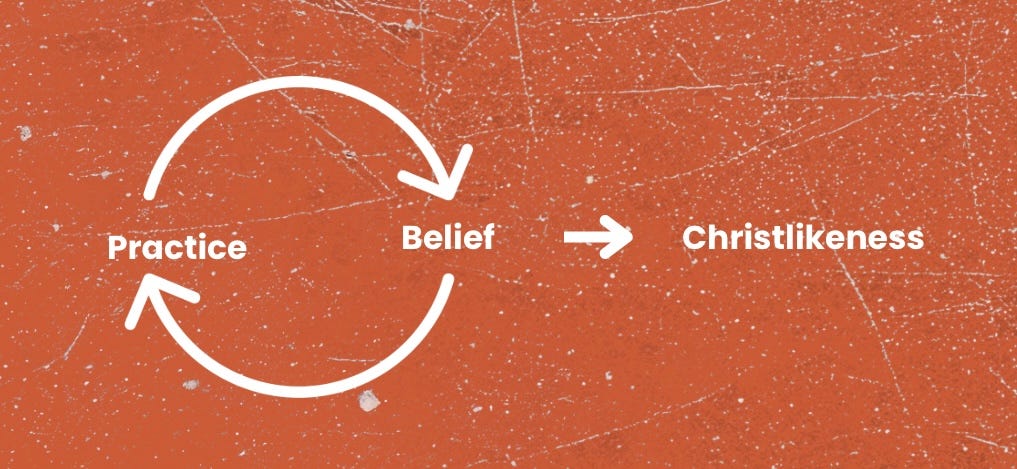
As such, habits ferment us—making our beliefs and lifestyle finer like aged wine.
My Personal Stake in the Habits Convo
I was on a podcast recently where someone said they were excited I was writing a book on happiness because I seemed pathologically happy.
Which was funny, because that’s not how most people who’ve known me before a few years ago would’ve described me.
I used to be a loud and proud pathological pessimist. It didn’t matter to me if the water was half empty or half full because that water would probably be gone soon enough anyway because we’re all going to die one day or in some way or another.
I once took a personality test that told me the closest celebrities to my personality type were Friedrich Nietzsche or the villain from the Skyfall James Bond movie.
Early on in my master’s program, I wrote a paper against the prosperity Gospel—you know, the belief that Christianity is all about health and wealth and fame and power and beauty. The prof graded it well, but wrote as a comment:
You’re right about all the health and wealth stuff, but Christianity isn’t all about doom and gloom. In fact, some early Christians even thought it was the best possible theory for happiness.
And I kinda shrugged it off, like okay professor heretic. But within a year of reading some Justin Martyr and Irenaeus and Origen and Augustine and Boethius and Aquinas and Jonathan Edwards, I conceded to taking away professor heretic’s nickname: all these theologians considered Christianity the key to a happy life.
The difference is that it’s an upside-down kind of happiness: we become happy by centering our life first and foremost on God and others rather than centering it on getting what we want all the time. Real happiness—just like any real, Christlike habit—is the opposite of selfish because it’s about organizing our lives toward the joy of something beyond ourselves. And one way Christians stumbled into happiness was through unselfishly committing to lifestyles that de-prioritized their own well beings and magnified everyone else’s.
And so, over time and practice, I just became happier. All of which is thanks to the way the Spirit meets us in habits. Spending time in prayer is just better than sleeping in. Fasting is just better than giving my stomach everything it wants at every moment. Serving others with our time or money just leaves us more elevated than buying that Amazon product we’re gonna get bored of after a day or two.
We don’t control much in life; but habits control our outlooks enough to change a person. And a changed person is quite literally the most persuasive argument. It’s why people flock to weight loss plans advocated by people who’ve demonstrably lost weight—we want to know how they became what they became because we want to know how we can become like that too.
It’s also why the morning wakeup decision is so critical. Again, if we’re just trying to master a morning rhythm for maximizing personal happiness, we miss the point; but if we view our morning habits as a process of choosing the path of most resistance for the sake of narrowing our minds on God and becoming more vibrant for others, then we find good company among the past two millennia of faithful Christians.
Personally, I made it easier to get out of bed by putting caffeine far away and allowing the craving to coax me. Then I started putting my bottle of caffeine (a mix of Celsius, matcha, and electrolytes (don’t ask)) in the fridge past my office. So instead of grabbing it first thing on the way downstairs, I now wait until after I’ve spent time studying and meditating on Scripture and praying. Grogginess is a little brutal some mornings. But so worth it.23
“Christians Are Made, Not Born!”
In 256 A.D., Cyprian wrote
“Beloved brethren, we are philosophers not in words but in deeds; we exhibit our wisdom not by our dress, but by truth; we know virtues by their practice rather than through boasting of them; we do not speak great things but we live them.”24
Christianity isn’t about life hacking your way into smoother circumstances. It’s about abiding in all circumstances, regardless of smoothness. And as we follow, it gets us out of self-centered patterns of thinking and helps us focus more on God and others. And once we find that, it’s no surprise that we might find ourselves folded into a happy, beautiful, flourishing life—a life that radiates life to others.
I’m nowhere near arrived yet, but I have multiple people in my life who have. And their life is the most convincing argument; they make every step down the path of resistance seem worth it.
In Madeleine L’Engle’s words,
“We draw people to Christ not by loudly discrediting what they believe, by telling them how wrong they are and how right we are, but by showing them a light that is so lovely that they want with all their hearts to know the source of it.”25
Apologetics are wonderful—but the best apologetic is you.
Kyue Taek Oh, et al. “Using Wake-Up Tasks for Morning Behavior Change: Development and Usability Study.” JMIR Formative Research 6 no. 9 (2022): e39497.
Most of the examples of this are unfortunately from tweets or social media posts; very few argue this from the academic angle. This is one of the most blatant critiques of discipleship/disciplines from a reputable source that I would consider unhelpful. Conversely, I think Jen Pollock Michel’s A Rule for the Rest of Us is one of the best apologetics on the beauty of habits.
One notable example of this kind of criticism is in Gerhard O. Forde, “The Lutheran View,” in Christian Spirituality: Five Views of Sanctification, ed. Donald L. Alexander (Downers Grove, IL: InterVarsity Press, 1988), 13–32.
However, it should be noted that though this spread is impressive, it’s not entirely quick. The rate is roughly 3.4% growth every year. Take the distance between us and the founding fathers, then add roughly 75 years, and you’ll have an approximate idea of how long it took Christianity to become vibrant.
This is a central point from Michael Green’s Evangelism in the Early Church.
See Ramsay McMullen’s Christianizing the Roman Empire.
As some readers will have already discerned, I’m indebted to Alan Krieder, The Patient Ferment of the Early Church: The Improbable Rise of Christianity in the Roman Empire (Baker Academic, 2016), 1-5. Also, it should be noted that Krieder uses Bourdeau’s “habitus” as opposed to just habits, delineating a kind of social flow of habits that go beyond mere rhythmic actions.
It was also super strange among the ethics of the day—Aristotle would’ve probably laughed off the idea that being patient was somehow “good.” Like Alasdaire MacIntyre famously said, “Aristotle would certainly not have admired Jesus Christ and he would have been horrified by St Paul.” After Virtue (University of Notre Dame Press, 2009), 184.
Tertullian’s “On Patience,” Cyprian’s “On the Good of Patience,” and Augustine’s “On Patience.” Ya, could’ve probably used more creative titles.
Edward Yarnold, SJ, The Awe-Inspiring Rites of Initiation: Baptismal Homilies of the Fourth Century (Slough, UK: St. Paul Publications, 1971), 50-51.
But again: it wasn’t just an individualized set of habits, like brushing one’s teeth; the habits were socially mediated and followed a shared flow of life.
See Tom Holland, Dominion (Basic, 2019), Ch. 4.
“[T]he way faithful Christians die is the most contagious aspect of what being a Christian means.” Krieder, The Patient Ferment, 12, 52.
Even Justin Martyr and Tertullian’s apologies contain mention that the intellectual aspects of faith weren’t the most crucial part of apologetics—our lives are. Kreider, Patient Ferment, 2.
Origen, Contra Celsum, preface 2, trans. Henry Chadwick (Cambridge University Press, 1965), 4.
I love apologetics; but intellectual apologetics are almost more for our formation than for skeptics.
As Ronald Rolheiser wrote, “The novice’s mistake is to think that they can be sustained simply through good feelings and good intentions, without the help of a ritual container and a sustaining rhythm. That’s naive, however sincere. Love and prayer can only be sustained through ritual, routine, and rhythm.”
C. S. Lewis, Mere Christianity (HarperOne, 2001), 131.
N. T. Wright, After You Believe: Why Christian Character Matters (HarperOne, 2010), 224.
Irving L. Janis and Leon Mann, “Effectiveness of Emotional Role-Playing in Modifying Smoking Habits and Attitudes,” Journal of Experimental Research in Personality 1 (1965): 84–90.
See T. M. Luhrmann, H. Nusbaum, and R. Thisted, “The Absorption Hypothesis: Learning to Hear God in Evangelical Christianity,” American Anthropologist 112, no. 1 (2010): 66–78; T. M. Luhrmann and Rachel Morgain, “Prayer as Inner Sense Cultivation: An Attentional Learning Theory of Spiritual Experience,” Ethos 40, no. 4 (2012): 359–389; Michiel Lifshitz, Michiel van Elk, and T. M. Luhrmann, “Absorption and Spiritual Experience: A Review of Evidence and Potential Mechanisms,” Consciousness and Cognition 73 (2019): 102760.
Cyprian, Pat. 3, trans. G. E. Conway, FC 36 (1958), 265. Cf. Tertullian, Apology, 18.4, trans. T. R. Glover, LCL 250 (1931), 91.
Madeleine L’Engle, Walking on Water: Reflections on Faith and Art (Convergent Books, 2016), 172.
very good post that expands upon much of what I've been thinking about recently regarding formation and apologetics.
reminds me of the sign at a bible college I was a guest at for many months said: "your life may be the only bible someone ever reads."
This is good stuff, Griffin! I’m glad you came out of your cup-half-empty-it’s-all-gonna-burn phase into “the happy guy”.
You express things I’ve stressed over the past few decades much more eloquently than me & I’m glad your voice is being heard by many younger gens.
It’s ironic how simple the Christian way of life is & how simple but valuable habits become integral elements of our example to others.
I think us Westerners make it more complex than it needs to be. If you teach the way you write, I’m certain you are helping your students in ways that will last & even surprise you & them in the long run.