


Audio voiceover available here for paid subs!
Every friendship I’ve ever had kicked off over a shared experience. My best friend and I initially bonded through our mutual appreciation of 2000s indie music. I feel an immediate kinship with anyone who also loves footnotes.1 Sometimes it’s even a collaborative dislike of something everyone else unabashedly loves.
Yet it’s odd that even though we connect with one another best through shared experiences—and connection is one of the most joyful forces in the universe—we rarely share one of the most basic human experiences: rejection.
Whether it’s rejection from a dream job, grad program, relationship, publisher, literary agent, sports team, volunteer position at a local cat rescue shelter,2 scholarship, or medical trial, everyone knows the sting of rejection. It’s why lots of stories begin with the main character experiencing social ostracism (Catcher in the Rye, Harry Potter, The Bell Jar, Joaquin Phoenix’s The Joker, Perks of Being a Wallflower, and the most highbrow of all, Rudolf the Red-Nosed Reindeer): the audience immediately connects with them because everyone—even the most popular among your high school, community group, or local cat rescue shelter—empathizes with rejection. And yet, it’s probably the experience we’re least excited to bring out in the open.
Which is probably because it’s uniquely painful. Several studies have demonstrated that the areas of the brain that register social rejection overlap with the areas that register physical pain; rejection can feel worse than getting hit by a car.3 These parts of the brain are so intertwined that one group of researchers even found that taking Tylenol can lower the intensity of social pain.4
When I was younger, I was so petrified of this social pain that I rarely set goals. But after I started setting some, I realized that no methods for circumventing rejection actually existed. Nowadays, rejection emails from jobs, journals, and publications storm my inbox like a SWAT team on a weekly basis.
And even though every one still stings, they’re a necessary byproduct of trying. Along with death and taxes, rejection is a certainty of living: it’s a reminder that you’re alive and pushing toward something. Sidestepping all rejection is symptomatic of not trying—which might feel comfortable but doesn’t compute with growing toward the joy within the callings that God’s laid out for us (Eph. 2:9-10).
Rejection hurts and will always hurt a little bit. But if we train our nervous systems to receive rejection as an opportunity for maturation—rather than an invitation into sustained bitterness—we can alchemize the rejection into something that makes every rejection worth it.

And personally, I find that I’m immediately attracted to people who share rejections. Opening up about failure is a top-shelf social glue. So in the spirit of encouraging rejection transparency, I’d like to offer
a collage of rejection.
There’re too many places I could start. My natural lack of sportiness got me cut from most sports from first grade to freshman year (and I didn’t start making the team after freshman year, I just interpreted the cues that sports weren’t my thing). Or there was the time my seventh grade romance that basically only existed via Facebook messenger was broken off on the bleachers during PE.
But let’s just start with writing. I started writing when I was 22. And since I figured Christian writers wrote for Christianity Today, that’s what I should do. 155 essay submissions later, no dice. But sadly (and very understandably; a CT employee once described their submissions inbox a “never-ending slush pile”), there wasn’t much feedback. So I knew I was doing something wrong, but didn’t know what.
Then I started branching out and made a habit of submitting to a list of publications at least once a week. I did this for years before anything got accepted. Take a gander:
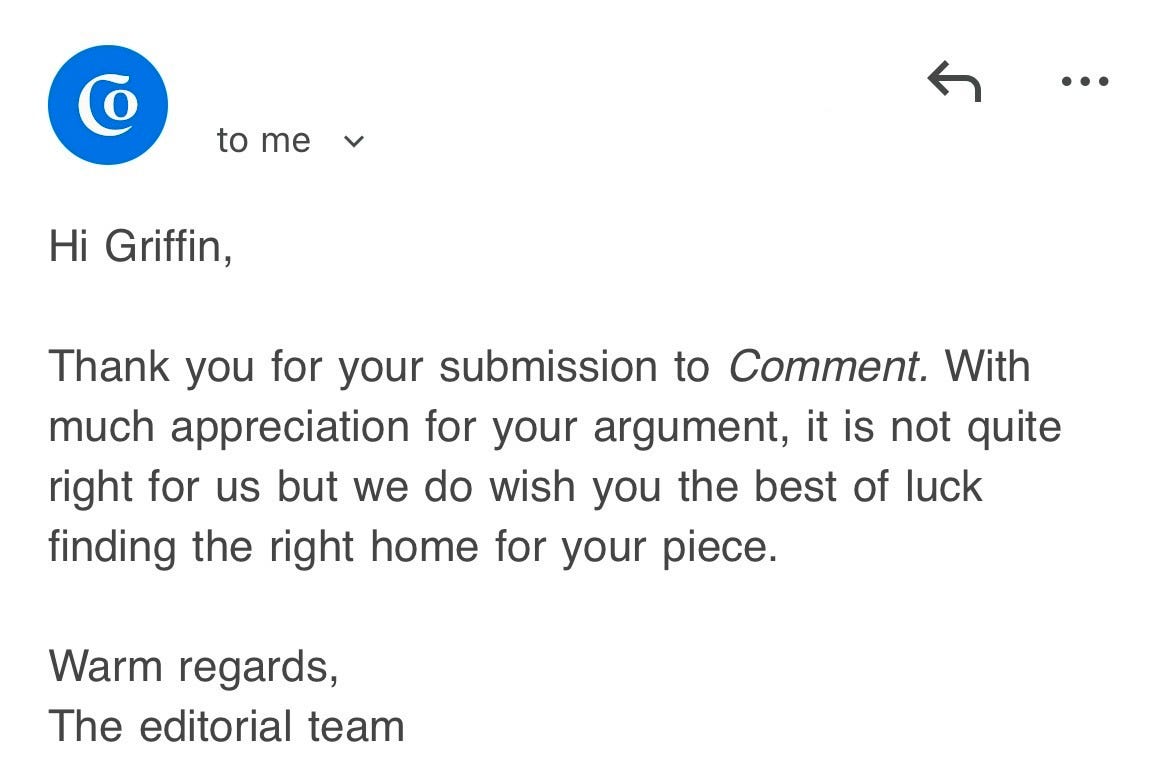
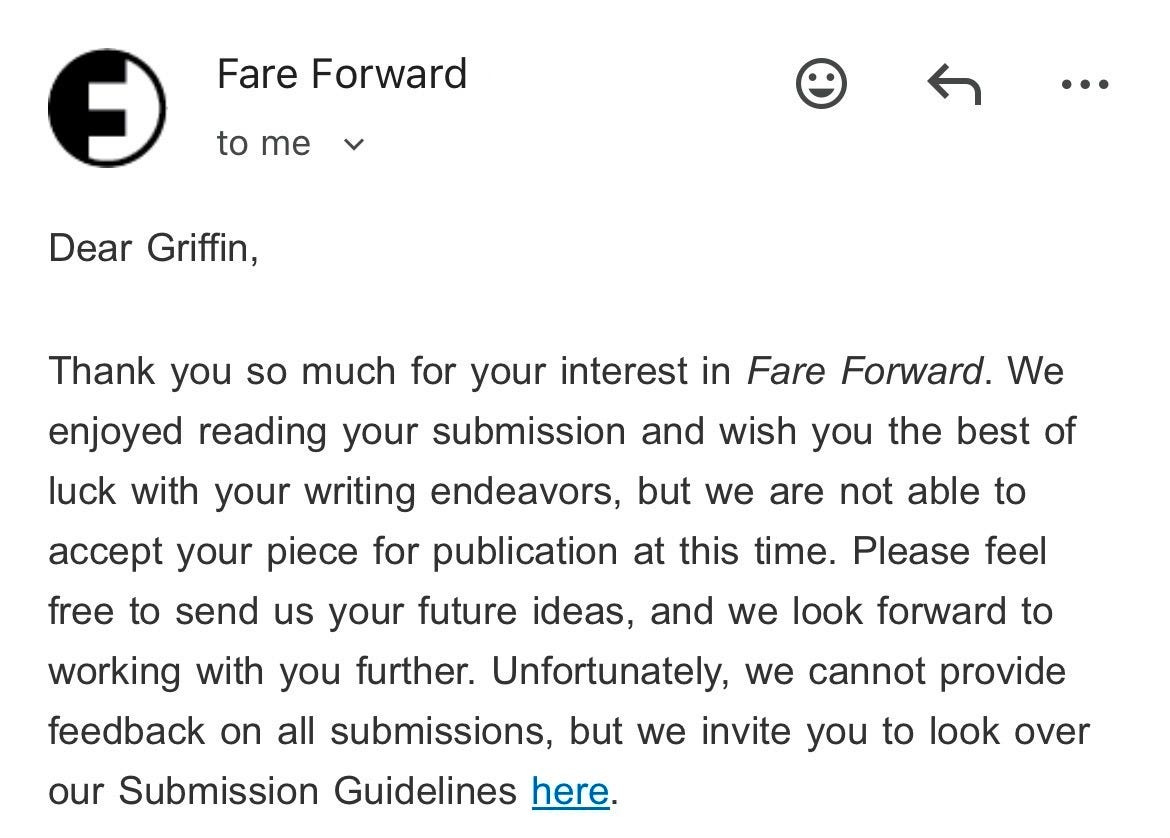
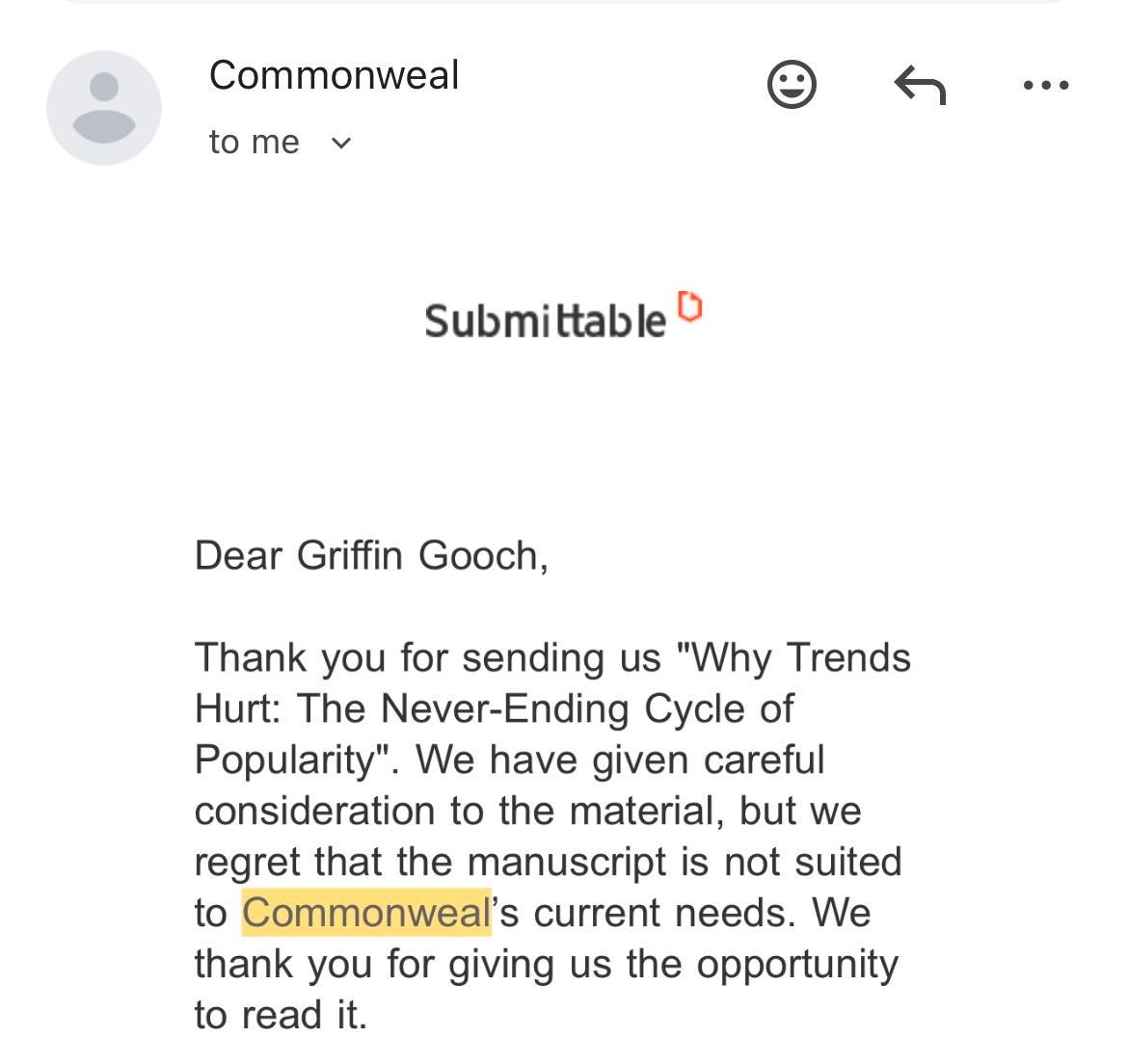
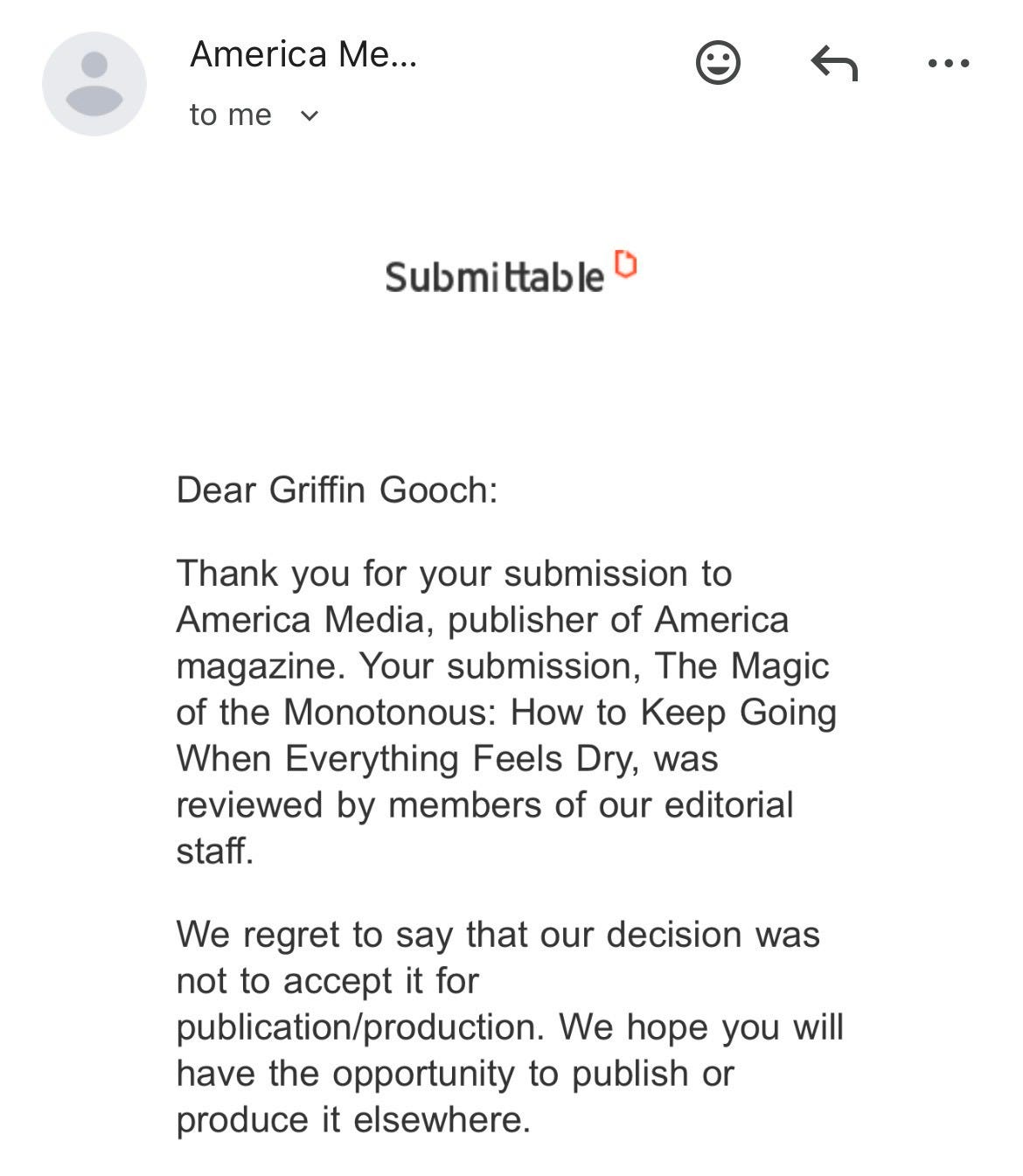


I have about 80 rejections Plough. I keep submitting essays periodically in anticipation that they will reject it within a comically short time frame.

Let’s also note that most of the bigger publications don’t send rejection emails, they just ghost you. So imagine about 250 actual rejection emails and then 400 assumed rejections and you’ll have a mental image of how many I stockpiled.
And that’s just magazine submissions. The rejections from publishers and academic journals, if printed out, could fill up about quarter of a paper ream. My friend Austin Suggs keeps a folder specially dedicated to rejections from publishers.
Then there are job rejections. The first one is mine, the next is Jessi’s, and the last one is Zack Gross’s from Bridgetown Church (that one must’ve stung):



I also shouldn’t tiptoe around two of the more painful rejections of all, one from my alma mater and the other from Oxford:

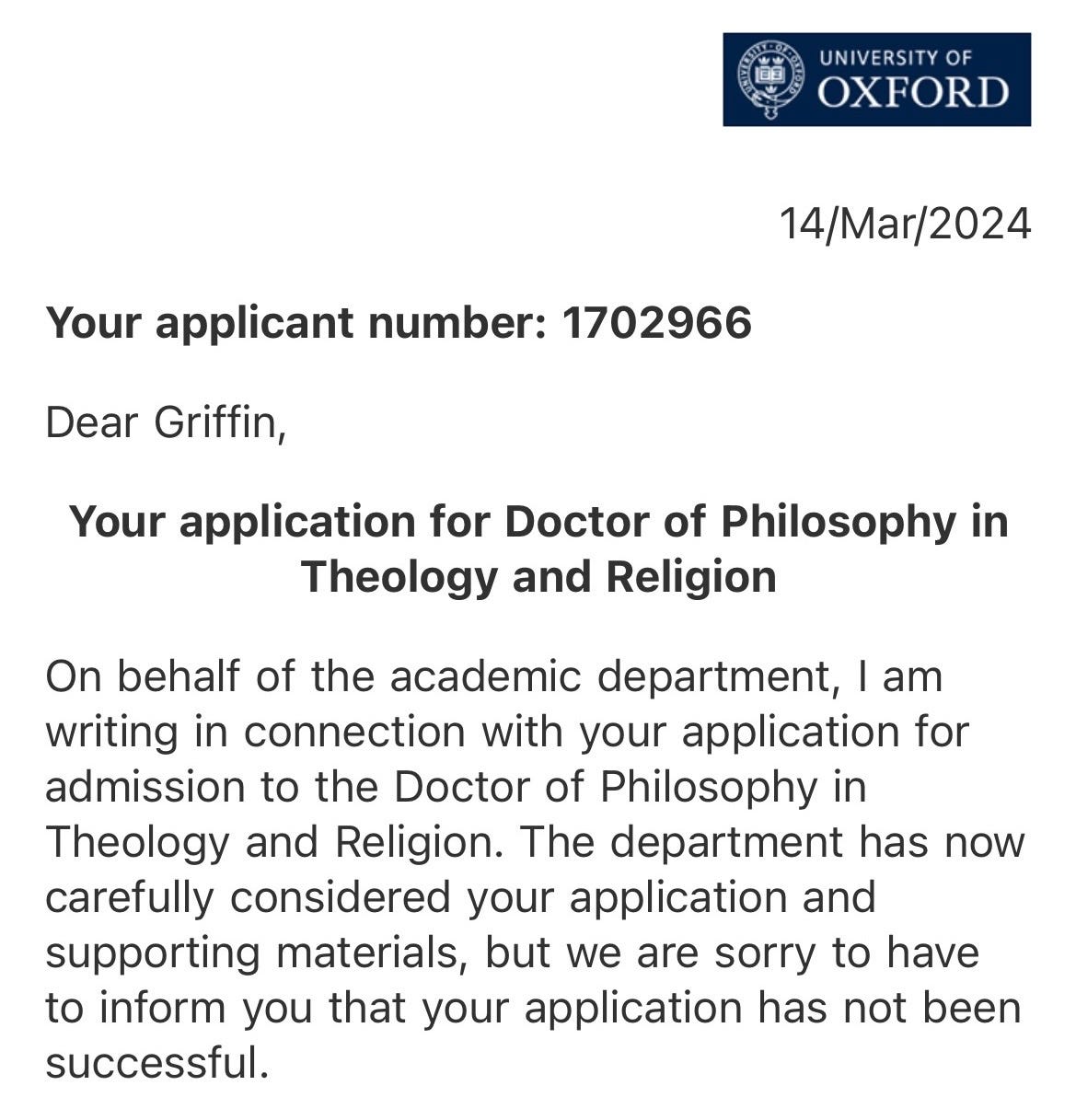
Now, for the record, I did get published, I did get a job, and I did start a doctorate. But along the way, I had to weed through endless cycles of rejection—and I still receive rejection constantly.
Thankfully, every once in a while, you get a rejection email paperclipped with some advice. Take Conor Sweetman’s from back when Inkwell was Ekstasis:
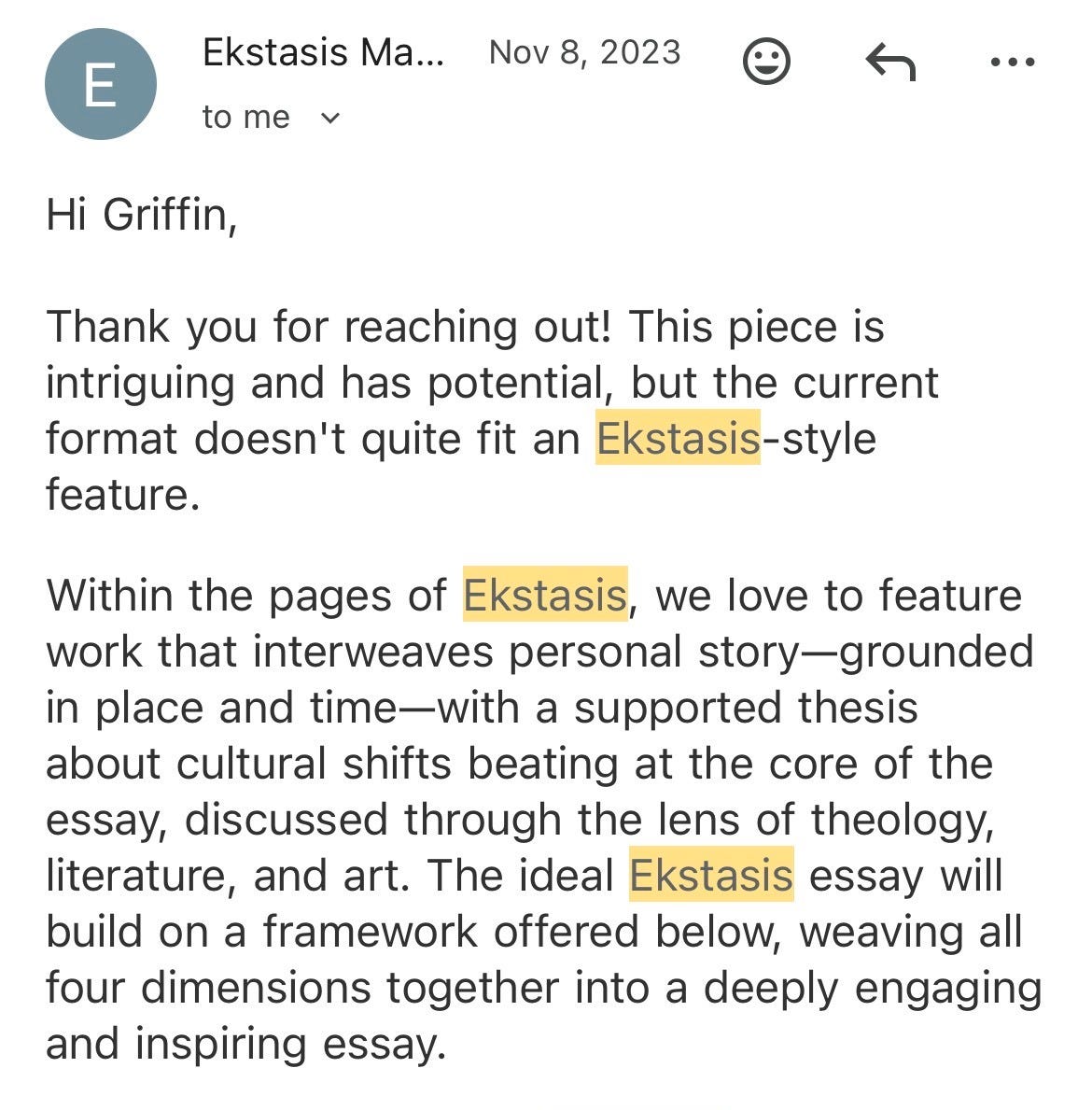
To this day, it’s the best rejection email I’ve ever gotten. It explained exactly what was wrong with my submission along with the chance to revise it, resubmit it, and then eventually publish it. It’s the kind of email more publications should shoot next gen writers.
Now let’s talk about
a theology of rejection.
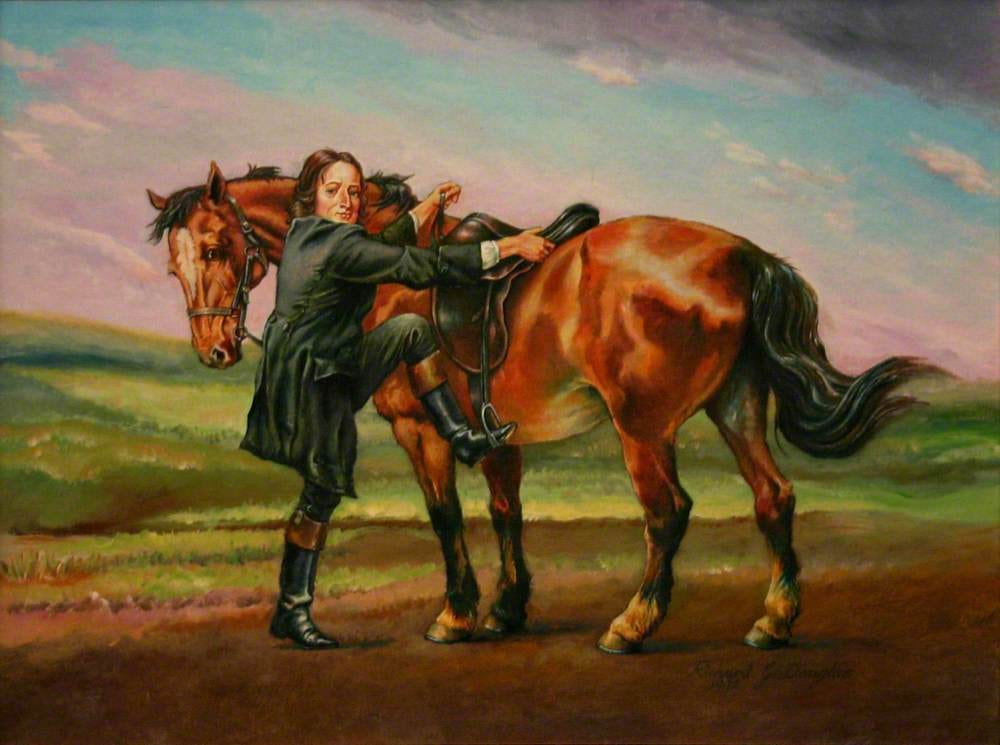
The horseback revivalist John Wesley wrote a lot of great stuff, but his travel journals are my favorite. For years, he kept a running diary of when and where he preached and noted his progress or lack thereof. They’re actually kind of funny:
Wednesday, October 20: At noon, I preached in the middle of town. No one accepted the Good News. Later, they came to the house I was staying at and tried to kill me. The owner would not let them.
Friday, October 22: At eleven, I preached in the town next over. Not one attentive person in the crowd. Then men started shouting me down. None were saved.
Sunday, October 24: I preached at noon, and the crowd listened intently. Dozens came forward. I’d never seen a crowd so enthusiastically receive the Gospel.5
What I love most about Wesley’s journals is that his progress was never linear. He never arrived at a plateau where all of his preaching became successful. No matter how many supported him, there were always just as many, if not more, who rejected him. Wesley’s journals remind us that rejection is just a normal occupational hazard for Jesus’ followers.
The New Testament is crammed with rejection—probably because the Christian life itself is crammed with rejection. Jesus casually tailored His disciples’ initial commission with advice for rejection: “If that town doesn’t receive you, depart and shake that town’s dust off your feet,” “When you’re arrested, don’t worry how to speak, because the Spirit will speak through you” (Matt. 10:11-15, 19-20).
Unlike the existing philosophies of the day, which typically encouraged growing a vague numbness toward rejection,6 Christianity revolutionized rejection. James encouraged us to count trials of all variety as “joy” (James 1:1-2). Jesus even crescendos His Beatitudes by saying that those who “suffer for [His] sake”—getting “reviled” “persecuted” and “slandered” (Matt. 5:10-11)—will enter into His flourishing life. Essentially, He’s saying that those who are single-mindedly devoted to the Gospel will be happier than those who are double-minded and stuck choosing between safeguarding their earthly status or storing up heavenly treasure.
While Christians will still, of course, experience the pain within rejection, we’re given a framework to receive rejection without internalizing its lingering aches. It’s like an authorization to interpret rejection as a tangible sign that we’re aligning ourselves with the abundant life Jesus outlined for us.
But yes, there’s a noteworthy chasm between the seriousness of getting “flogged in synagogues” (Matt 10:17; John 16:1-2) and losing out on jobs or getting non-fiction personal essays rejected. Let’s make every effort to stave off messianic complexes. Yet simultaneously, there’s no real reason to downplay the resistance that we face on the way toward whatever God’s called us to. The early apostles knew a rejection many of us never will, but that doesn’t nullify the discomforts we experience on a smaller scale.
So on that note, let’s discuss
four ways to metabolize rejection.
(1) turn it into humor
The comedy writer Nora Ephron once said, “When you slip on a banana peel, people laugh at you; but when you tell people you slipped on a banana peel, it’s your laugh.”7
Tasteful self-deprecation is a superpower. By reverse engineering embarrassing moments into humor, we trade the original embarrassment for a newfound relatability.

But notice the qualifying word “tasteful.” Someone who walks into every room and calls attention to the thing they’re most self-conscious about is someone who spends too much time considering how others see them. Humility is thinking about the self less, not obsessing so much over your failure that you can’t stop bringing it up.
We also don’t want to use humor as a cover up. If we make jokes about rejection, we should posture the joke so that there’s a detectable note of sincerity within it. Laughter is best used to process reality, not avoid it.
(2) turn it into art
The creative writer Austin Kleon once compiled a long list of famous rejection letters into an aesthetically pleasing article about saying no.8 Here’s my favorite:

Kleon’s whole essay humanizes both the rejector and the rejectee; by demystifying the process, his aesthetically pleasing collection turns an emotionally devastating experience into a few minutes of escapism.
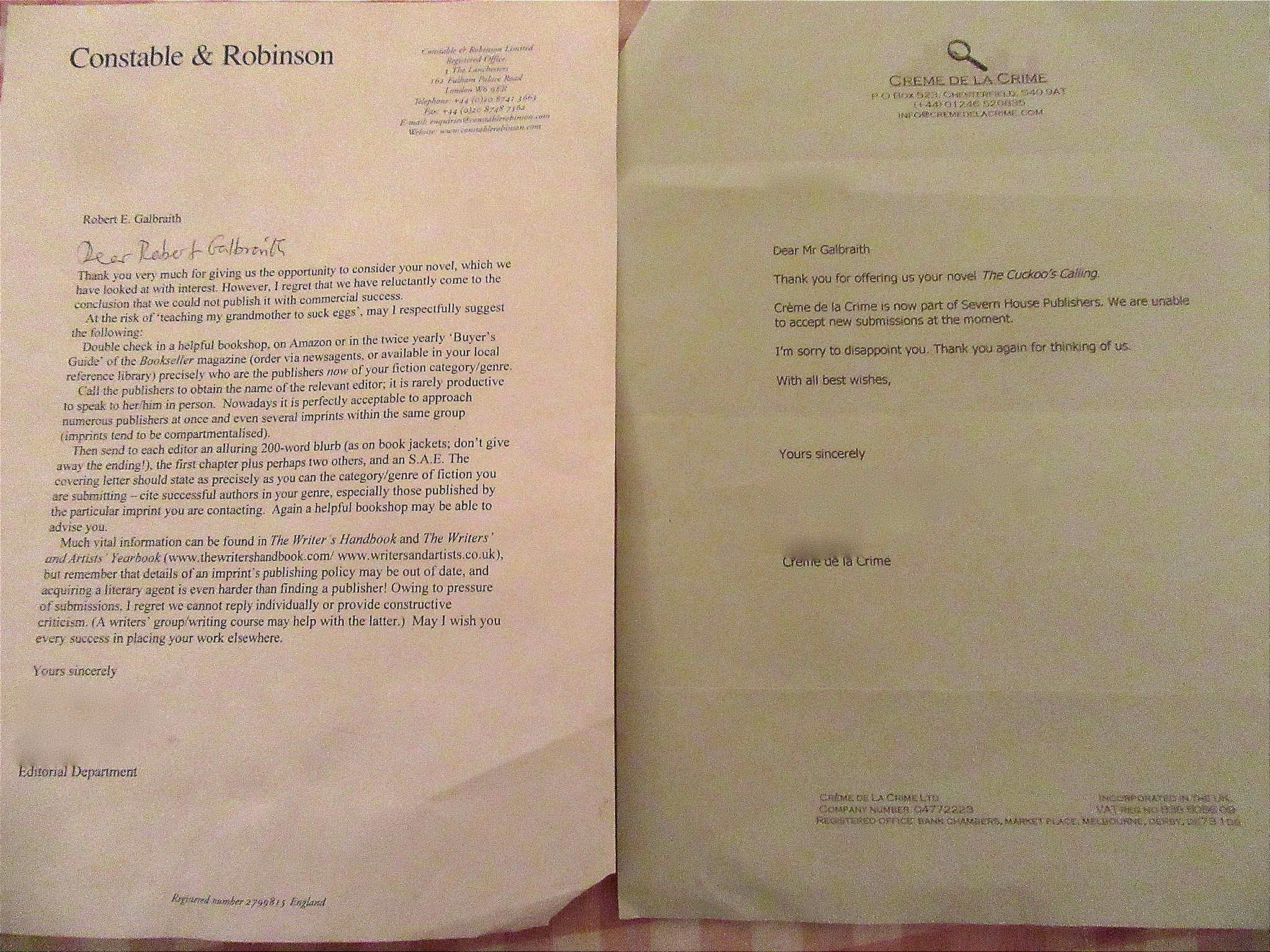
Then there’s J.K. Rowling, who submitted crime fiction under the pseudonym “Robert Galbraith” after writing Harry Potter. Posting her rejection letters showed every aspiring writer that a lack of talent wasn’t necessarily the reason they were getting rejected. Best part is, the letters offered her advice about how to write books that could have more “commercial success.”
Similarly, the theologian A.J. Swoboda once asked Wendell Berry to write a preface for his book on eco-theology. Berry said no. So Swoboda wrote up the process of getting turned down by Berry into an amusing anecdote for his follow-up book. He turned the rejection into a smile for his readers.9
Some experts even encourage young creatives to rack up 100 rejections just for the sake of growing some skin. This is sort of what The Call of the Wild author Jack London did early in his career. He plastered the sides of his room with rejection slips from publishers until it was hard to see any wall. He used it as a kind of motivating force until he eventually began covering up the rejection notices with acceptance notices.
And of course, you don’t have to be a famous writer to turn rejection into art. One study shows that processing the spiraling that’s going on in your mind by spiraling it out on paper tones down overall negative rumination.10 Regardless of your medium, art is great (and cheap) therapy.
(3) sharing rejection with embodied community.
While writing this essay, I got one of the most painful rejections I’ve gotten in years (I loathe it when Providence makes you practice what you preach). Because of the involved parties, it would’ve been too unprofessional to include here. I woke up one morning so excited for the day (I’m a morning person, so I peak around 5am and it’s usually all downhill after 7am), but then I checked my email and ended up getting next to nothing done. It felt like it whacked my stomach with a cricket bat.
And my first reaction was to conceal it. I was too embarrassed to tell my wife or my best friend. So I just sat in silence rereading the email and then got ready for work. But on the drive, I reluctantly realized that I shouldn’t just shove it down. I caved and told my wife and then got on the phone with my best friend later on. And it was instant relief. It’s so much better to suffer in community—inviting others to weep with you as you weep—than to do it alone.
I wonder if what made the apostles so much more willing and able to suffer rejection was knowing that they had their brothers and sisters constantly at their side. Since community was baked into their foundations, rejection wasn’t processed through an individualist framework—which meant there was way less schadenfreude and one-upping. Bearing one another’s burdens is easier when there’s zero degrees of status differentials and a win for one is a win for all and vice versa. Maybe modern individualism is what makes rejection so uniquely painful.
Bring sadness into your communion with God, of course; but the embodied comfort from embodied community is so crucial.
(4) use rejection to motivate others.
Lots of the people I look up to share a similar quality: they seem happier bottling up successes than failures. You know, the kinds of guys who confess that they’re struggling with patience toward their family but also run a 5,000 employee company that you only hear about through the grapevine.
I’ve always found something strangely intelligent about those who share rejection. In one sense, it’s a cathartic exorcism of embarrassment. But it’s also just a smart way to motivate others.
For example, the social scientist Xiaodong Lin-Siegler set up a study where her and her colleagues delivered a lecture to one group of students about the failures and eventual successes of famous scientists, and then lectured the next group about the same scientists but blotted out their failures. Apparently, the group that heard about the setbacks amidst the successes was more excited and optimistic than the group who only heard their triumphs—with some even expressing a desire to become a career scientist.11
In other words, the ability to pick oneself back up again after the umpteenth failure is just plain inspiring. Therefore, if we’re trying to raise up scientists, let’s weave in our setbacks on the way to progress; if we’re trying to raise up ministers, theologians, and faithful leaders for the next generation, let’s make sure to shine the brightest spotlight of the adversity we faced in our personal testimonies.
There’s even something motivational about the way Jesus was “despised and rejected by men” (Isa. 53:3). Knowing that the man who lived the fullest life, who knew best how to experience the whole spectrum of human emotion, was perpetually rejected offers us a model of what makes any and all suffering worth it. The stone that was constantly rejected became the cornerstone of all of our reality.
Okay, time to
end.
There’s lots of talk among self-help literature about learning how to “fail better” or “fail smarter.” This isn’t that. We don’t just want to self-help ourselves into metabolizing failure. We want to aim toward the calling God’s laid out for us before the foundations of the world and interpret pushback as part of the necessary sufferings within Jesus’ beatitude. This doesn’t mean we shouldn’t feel sad about rejection—we should wallow over a disappointing rejection.
Sometimes, you get rejected because you’re not the right fit. Other times, you get rejected because you’re not good. When the problem is the former, it’s just a matter of finding the right niche. When the problem is the latter, as it was (and still frequently is) for me, the rejection itself becomes the antibody for growth. Like Marcus Aurelius said, the things that impede our actions are exactly what guides us toward future actions, “what stands in the way becomes the way.”12
Lastly, I’ve been absorbed with this book by the 17th century French mystic Jeanne Guyon called Experiencing the Depths of Jesus Christ. It’s one of the most insightful works on spiritual formation I’ve ever read. There’s one line toward the end that I’ve been sitting on:
Learn to suffer all that happens to you—even confusion—but learn to do so out of only one motive: love for God. Accept everything, whether it be ill treatment, neglect, or whatever else may come your way…Put to death the disagreeable feelings which rise up inside of you when unpleasant things enter your life. In so doing, you join in the sufferings of Christ.13
And again, to compare receiving a rejection email to the sufferings of Christ is a level of melodrama I’d rather never insinuate.14 But her larger point is endlessly relevant: learn to suffer for the sake of love of God. Like Henri Nouwen put it, rejection is never the final word. God’s love is.15 This isn’t just a naive optimism: it’s a rational exposure therapy to make all suffering meaningful and ultimately beautiful.
Have any fun or interesting or embarrassing rejection stories or emails that you want to share? Throw them in the comments, email replies, or restack this post with your most notorious rejection letter.
Among Substack friends who love footnotes, I’m thinking Mason King and Deidre Braley.
A real position my wife was rejected for a few months ago that were still scratching our heads over — like, it’s free labor and she’s not a felon, so why reject her help with no explanation? These things keep us up at night.
M. Zhang, Y. Zhang, and Y. Kong, “Interaction Between Social Pain and Physical Pain,” Brain Science Advances 5 no. 4 (2020): 265-273; N. I. Eisenberger and M. D. Lieberman, “Why Rejection Hurts: A Common Neural Alarm System for Physical and Social Pain,” Trends in Cognitive Science 8 no. 7 (2004): 294-300; G. Macdonald and Mark R. Leary, “Why Does Social Exclusion Hurt? The Relationship Between Social and Physical Pain,” Psychology Bulletin 131 no. 2 (2005): 202-223.
C. N. Dewall, et al., “Acetaminophen Reduces Social Pain: Behavioral and Neural Evidence,” Psychological Science 7 (2010): 931-937.
This is a paraphrase; John Wesley didn’t write this casually (or clearly). For the actual journal entries, see John Wesley, The Journal of John Wesley, in The Works of John Wesley, ed. Thomas Jackson (London: Wesleyan Conference Office, 1872), vol. vi, pp. 378–379, 415-417.
Diogenes Laertius, Lives of Eminent Philosophers, 6.22–105, trans. R. D. Hicks (Cambridge, MA: Harvard University Press; London: William Heinemann, 1925).
Nora Ephron, I Feel Bad About My Neck: And Other Thoughts on Being a Woman (New York: Vintage Books, 2006).
Thanks to Ruth Gaskovski for sharing this one!
A.J. Swoboda, The Dusty Ones (Grand Rapids, MI: Baker, 2016), 104.
Rumi Yun, Sam Fardghassemi, and Hélène Joffe, “Thinking Too Much: How Young People Experience Rumination in the Context of Loneliness,” Journal of Community & Applied Social Psychology 33 (2022): 102-122.
Xiaodong Lin-Siegler et al., “Even Einstein Struggled: Effects of Learning about Great Scientists’ Struggles on High School Students’ Motivation to Lear Science,” Journal of Educational Psychology 108, no. 3(2016): 314-328.
Marcus Aurelius, Meditations, trans. George Long, 5.20. The irony of quoting a stoic here is not lost on me.
Jeanne Guyon, Experiencing the Depths of Jesus Christ, trans. Gene Edwards (Goleta, CA: Christian Books Publishing House, 1975), 110.
But simultaneously, there is something fascinating about how Paul says that he “rejoices in his suffering and fills/stores up what is lacking in Christ’s affliction” (Col. 1:24). It’s an insane verse that I feel like is rarely given adequate attention.
This is a paraphrase of ideas littered throughout Henri Nouwen, Life of the Beloved (Seattle, WA: Crossroads, 1992).
Being mentioned in a footnote about our mutual affection for footnotes is the chefs kiss of footnote friendship.
Refreshingly and scarily vulnerable stuff here. Poignant as I'm in the rejection trenches with a fiction manuscript, a poetry manuscript, and the constant rejection churn with essays and reviews.
You are a gift because you don't shy away from exposing the reality of your practice. Most people at your level of popularity and readership become a version of themselves, a public-facing avatar. And it always smacks of the grift. But you lean so far in the opposite direction. Well done.